
The Architecture of Set Design
Studying architecture at Berkeley is brutal. I can’t find any other way to describe the feeling of repeatedly taking abuse from studio courses semester after semester. Deadlines rule my life: barely making them, sometimes missing them entirely… I find myself always fighting the clock, pushing away dreams of sleep and saying no to plans, all for my design to get nuked on by some grad student during the next morning’s critique.
What really weighs on my mind, though, is that through this entirely uphill battle, my future success as an architect will never be guaranteed. It’s really all just one big fat leap of faith.
At least for other majors with difficult course loads, take any form of engineering for example: one can sort of rest easy knowing that they will have a high-paying, stable job calling for them post-grad. But when my fellow architecture undergrads begin telling me that they definitely aren’t considering becoming an architect for their future selves’ sanity, that’s when I really start to question my own future.
Low pay, long hours, and never-ending license renewal tests—young architects are meant to put up with casual abuse under the sliver of hope that they will somehow make it to become a partner at some successful firm. Only a rare few will actually achieve this dream in their lifetime.
So, I really don’t blame my friends for considering career paths like UI/UX, product design, graphic design, or other more corporate functions of design that have much higher pay but are removed from the designing of inhabitable structures. I can see how these alternate applications of architectural schooling can lead to more personally fulfilling careers, because, unlike architecture, they don’t require you to sacrifice your personal health, happiness, and broader life goals.
In an attempt to look towards other possible futures, for both myself and my peers, I want to explore runway set design as a field that expands beyond the design of buildings—where architecture and fashion merge to form a more universal mode of design. For now, I have chosen a few runway sets from past shows that I find architecturally unique, moments where I see design mobilized to create otherworldly pockets of escapism.
Acne Studios’ A/W 2022
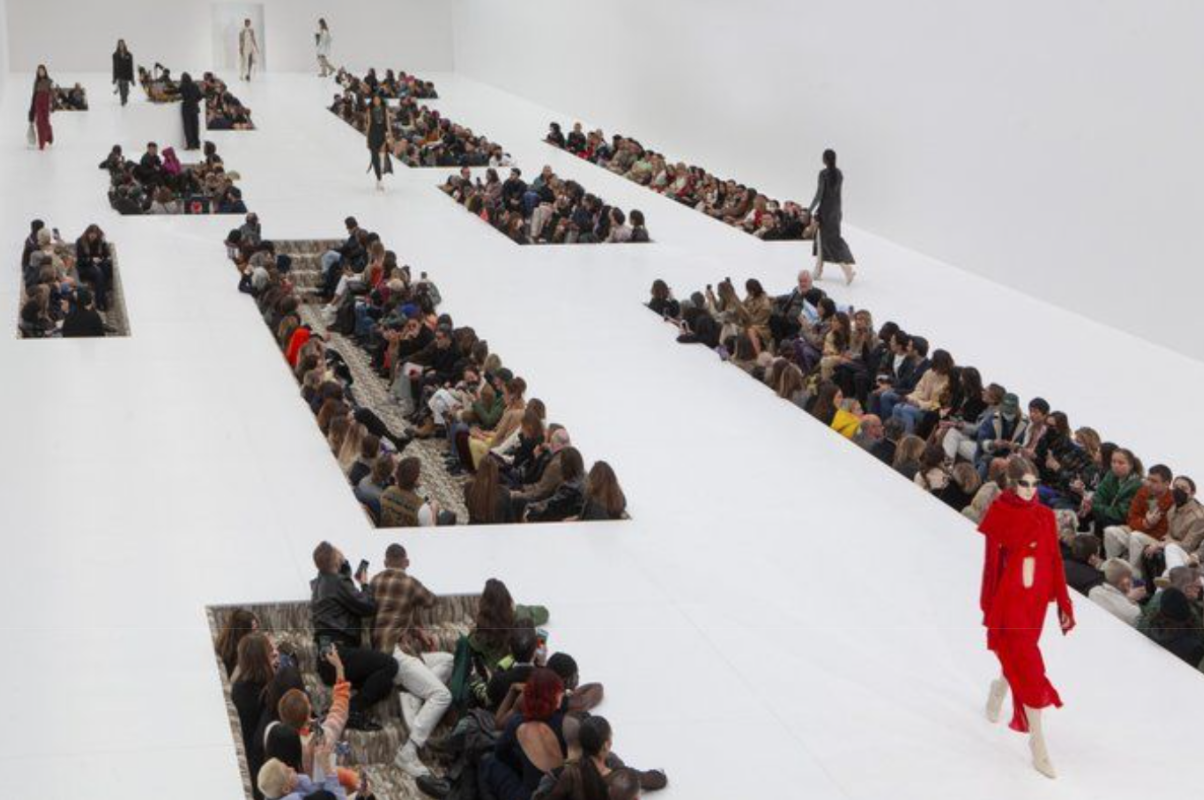
Location: Lycée Carnot, a historic secondary school in Paris, France
Date: 2 March 2022
Design firm: Back of the House
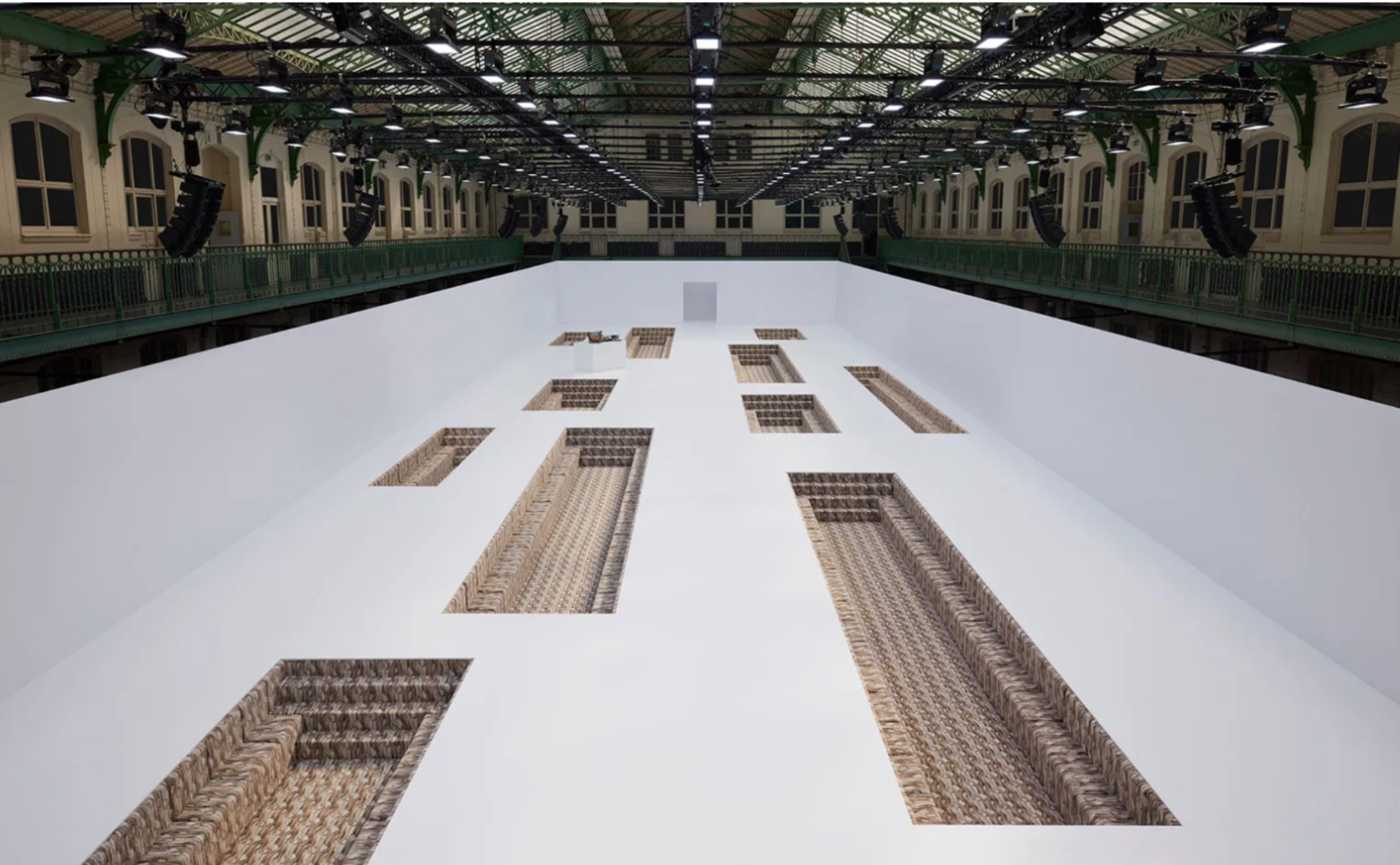
This runway set caught my attention due to how effective it was in its simplicity. I was interested in how a singular design decision of including sunken, conversation pit-like dips could transform the plain white hallway of a secondary school.
The runway set features a white, open space broken up by Back of the House’s choice of sunken “living rooms,” lined in retro fake fur carpeting. The set was meant to house not only Acne’s newest collection, but to frame DJ Suzzanna Ciana as she performed her live set.
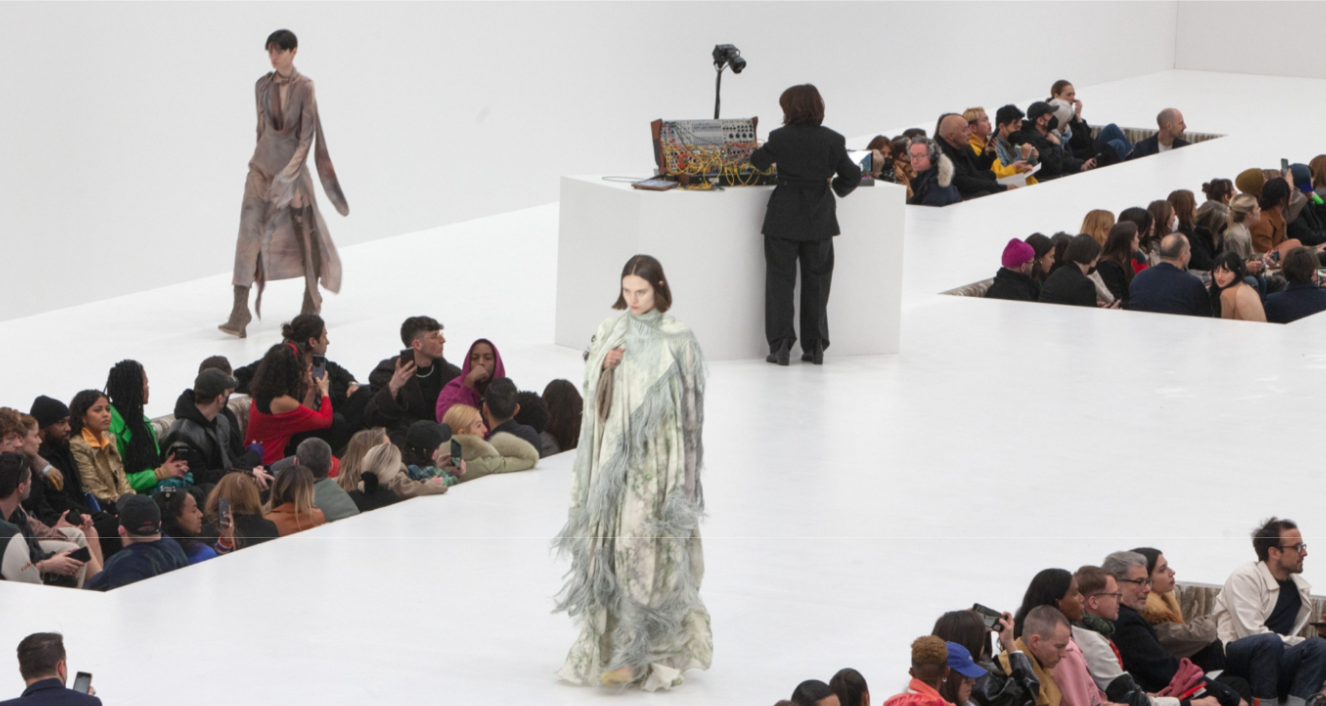
As Ciana’s synth was improvised on the spot, it called towards a nostalgia of the 1970s. A sense of nostalgia is also highlighted by the use of retro carpeting and the set’s conversation pit-like intervention in the first place—all of which reflect the collection’s argument on the regenerative nature of fashion.
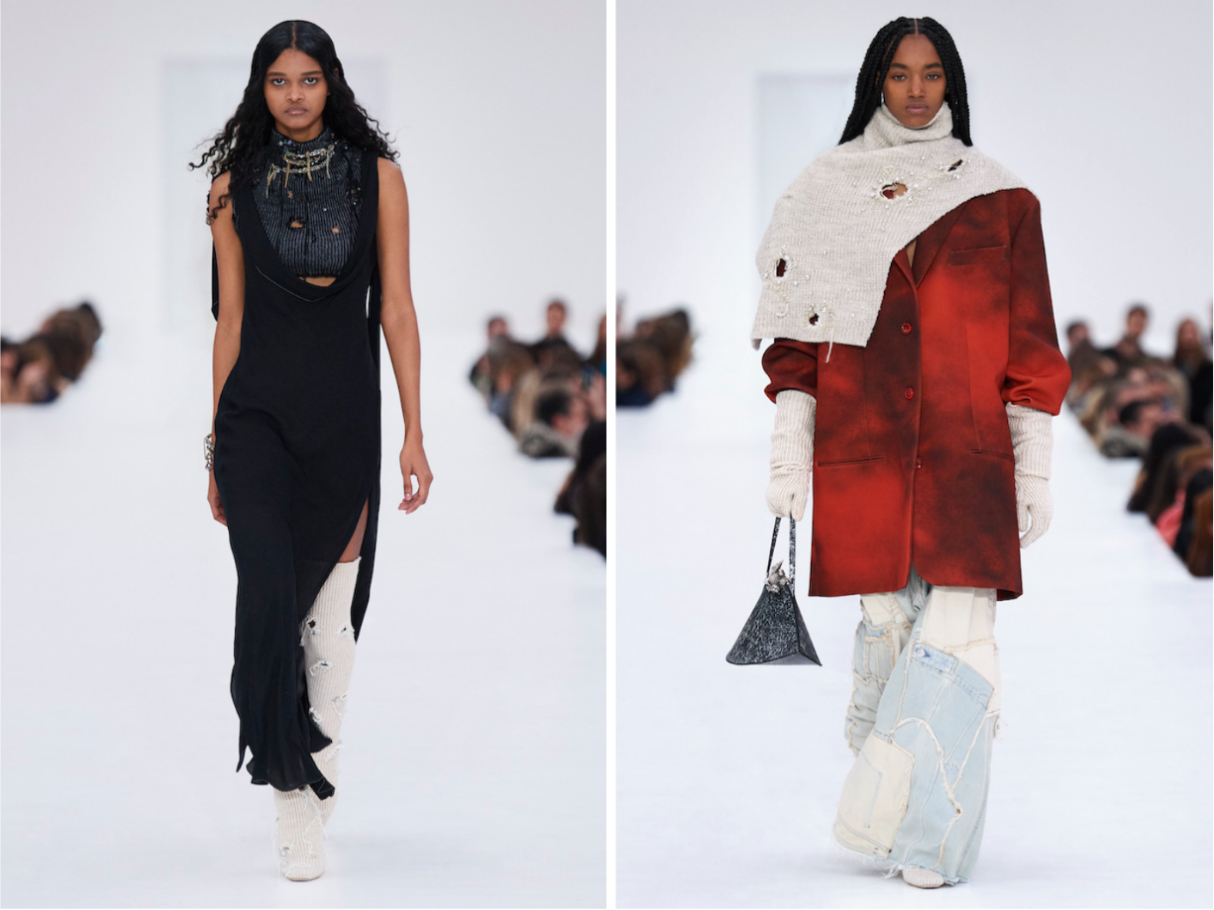
Some of the looks featured were made from denim scraps and distressed knits repaired with crystals, drawing from the act of making old items functional again.
Focusing back to the set, it feels stripped down to its bare bones to let the sunken seating speak for itself. The seating pockets of varying sizes are carved out from the mass of the runway floor. They work to define an offset grid-like circulation of movement for the models to traverse. Audience members sit facing each other, enclosed within the pits, making it so that people sitting opposite one another can view different designs at the same moment.
Rather than the traditional runway seating set-up, these sunken pits create a dynamic experience for the viewer, who is now given the autonomy to turn their head, look diagonally, or look behind them to take in multiple designs at any given moment. In this way, the set design takes the conversation pits that reached peak popularity in the 1960s and drops them into a modern, minimalistic context to bring new life to their original function.
Loewe’s F/W 2024
Location: Château de Vincennes in Paris, France
Date: 1 March 2024
Show Coordination: Holmes Production
Production: La Mode en Images
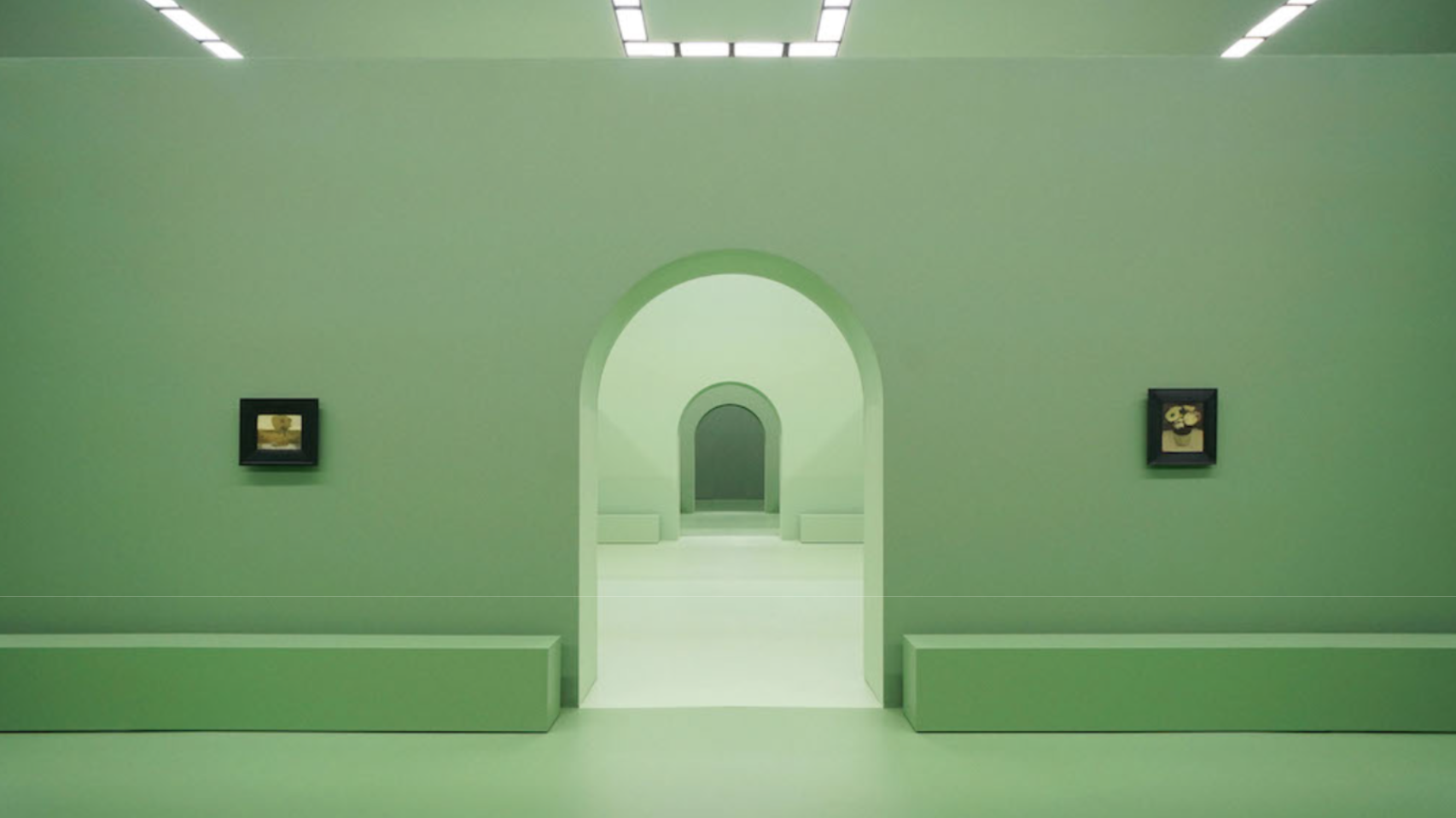
The maze-like art gallery frames a set of 18 by American painter Albert York’s works. York’s paintings are small yet powerful, focusing on idyllic pastoral subjects and floral still lifes. York’s work surrounds the idea that real paradise exists in our current reality—it is the here and now that makes up our Garden of Eden. The set design and Loewe’s collection come together to amplify this mindset of York’s miniature paintings.
The set unfolds as a series of rooms, whose entrances for circulation are created by subtracted arches, to create pockets of privacy separated from the totality of the larger show. Audience members can then focus on individual designs in their own dream-like bubbles of paradise. Seating occurs on rectangular masses that line the outer perimeter of each room. The peculiarity of this seating choice lies in its minimal design, with no backrests and a rigid cubic form, creating an atmosphere of intense formality.
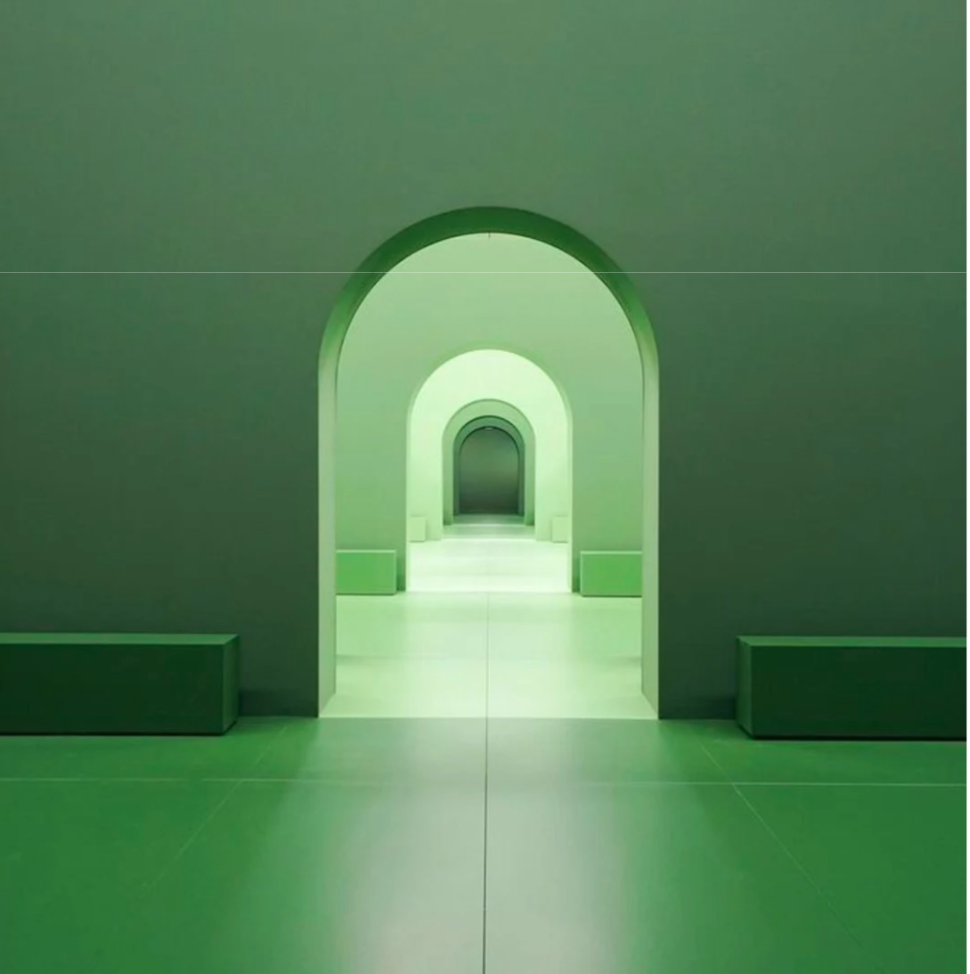
Only the most basic geometry is used to construct the set: the square, rectangular prism, and the perfect arc. The entire design is washed in only three slightly varying shades of green that draw from the palette of York’s paintings. The use of fundamental geometric forms and a homogeneous color scheme then begins to recall the simple, primal story told in the Garden of Eden.
The collection itself serves as a study of provenance: the mapping of how an object's history of meaning, value, and class association shifts as ownership changes. Jonathan Anderson, Loewe's creative director, arrived at this theme when he discovered that Jacqueline Kennedy Onassis, a classic symbol of American high-society taste, collected York's works. Anderson noticed how Onassis' ownership transformed York's humble natural depictions into works of fine art to be treasured by ultra-wealthy Upper East Siders.
The collection's design applied the concept of the shifting ownership by studying the origins of elite dress and subverting them into wearable pieces of modern art. Anderson took historic elite clothing symbols and transformed their materials and silhouettes to question their socially constructed value. The set design reflects this approach by creating the effect of an outsider looking in.
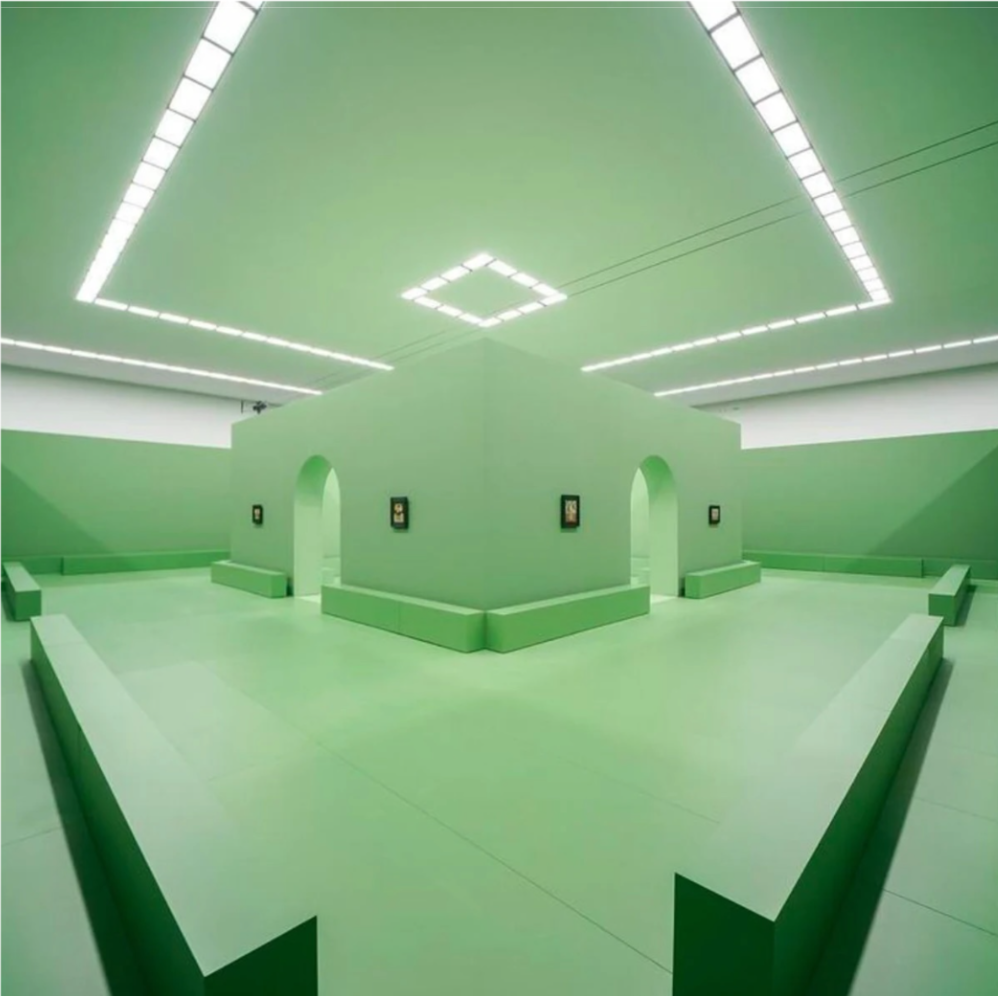
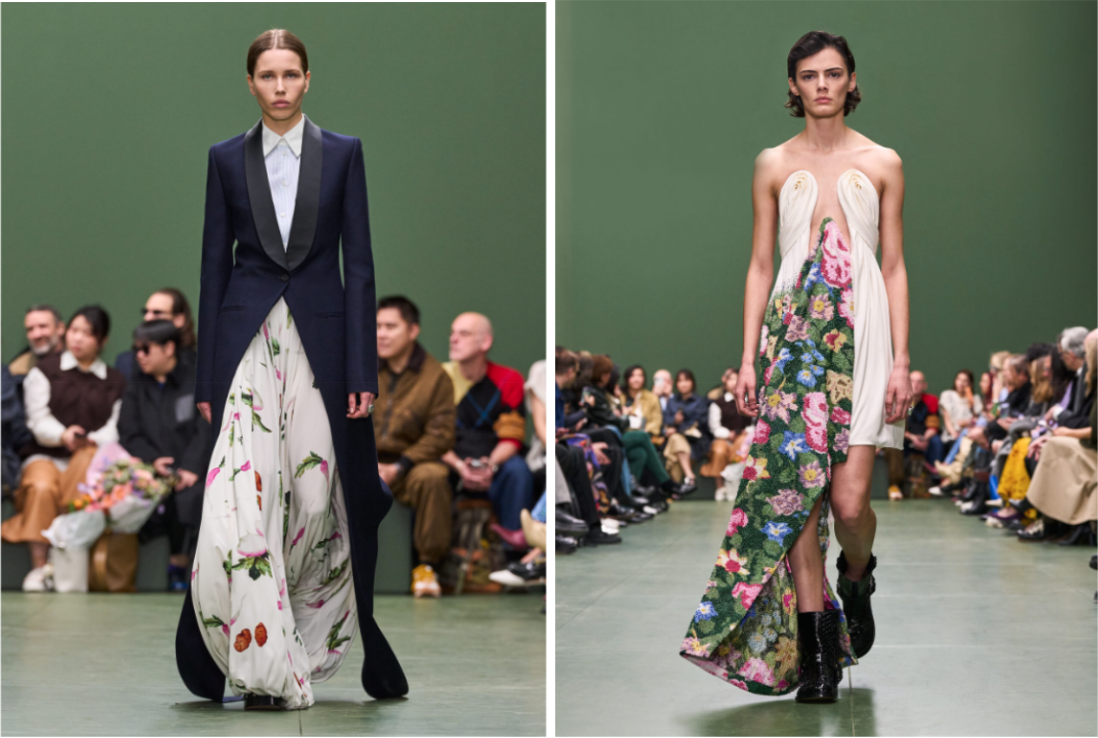
To be an “outsider looking in” means to only interact with the collection and York’s paintings as a spectator, not seeing oneself in either. The set design embodies such a concept by creating a distinction between who owns and is responsible for the art on display and who is simply meant to consume it—effectively exploring how ownership can change an object’s value. This is done especially through the orientation of the seating forms, but also through the set’s green color that washes over the audience. Loewe’s runway takes in the unsuspecting spectator and drops them into a surreal paradise, simply to observe works of art completely separate from themselves.
Prada Men’s A/W 22-23
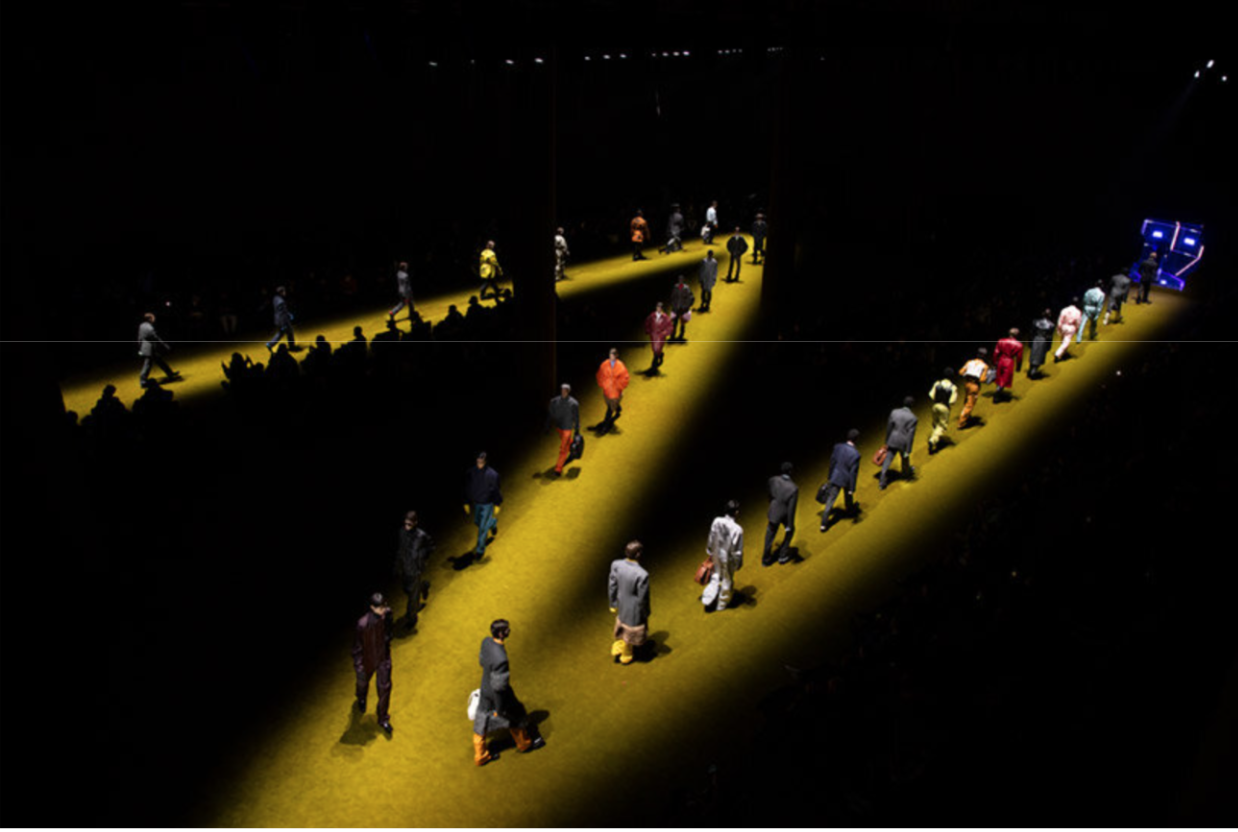
Location: Deposito hall at Fondazione Prada, Milan, Italy
Date: 16 January 2022
Design firm: AMO
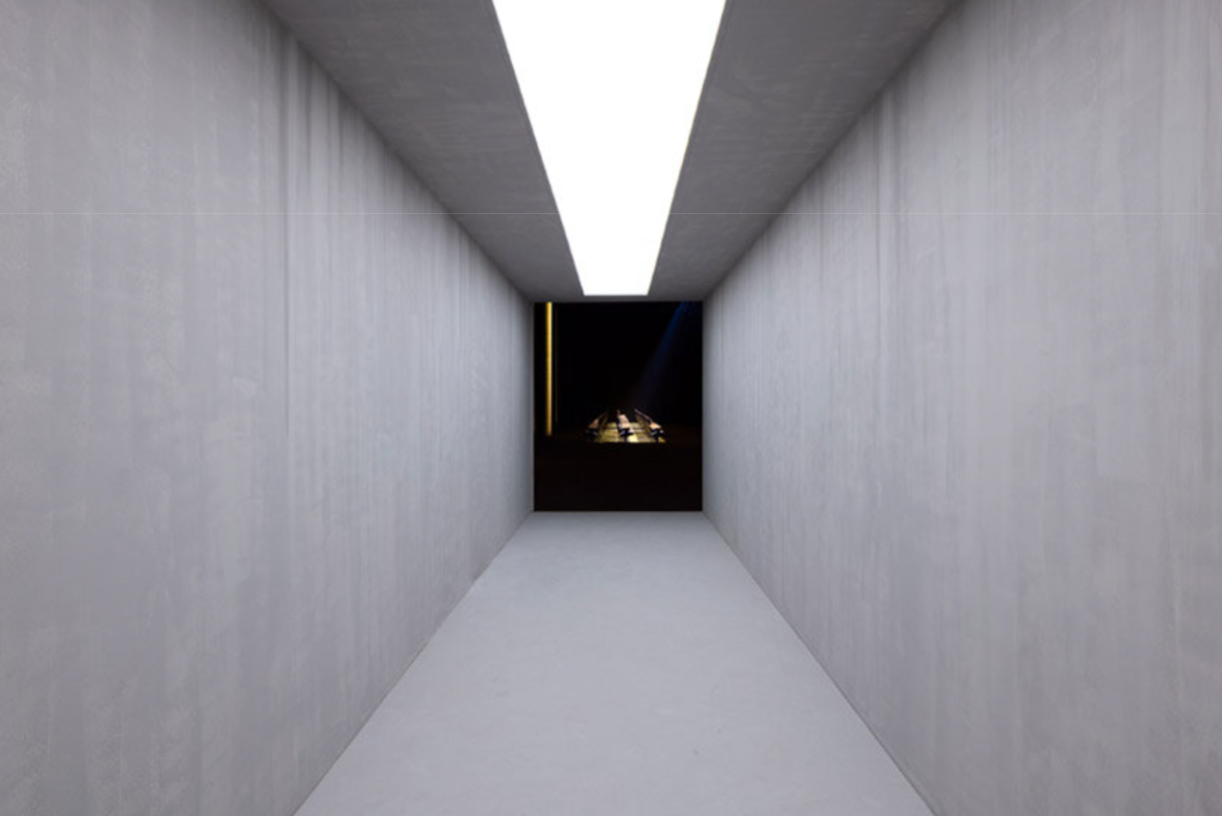
I was first interested in this set because of how it creates a progression of architectural events dictated by lighting, material, and color.
First, audience members must walk through a raw concrete tunnel that opens into the main runway space. This tunnel is completely bare, dulling one’s senses and working as a transition from the bustle of the outside world to the interior landscape of the runway. The tunnel allows for buildup of momentum as the audience anticipates the climactic collection that is to come.

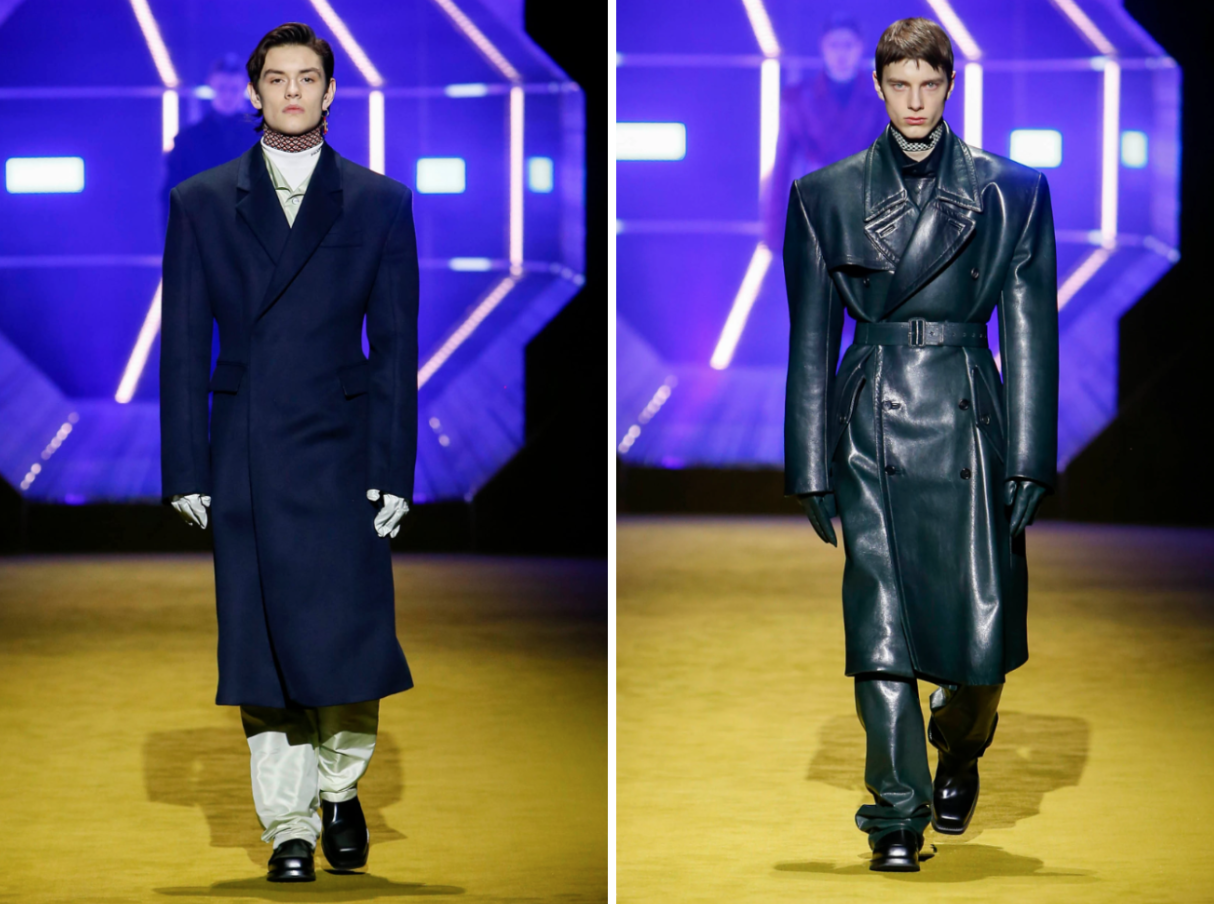
Past the tunnel lies the main stage where the runway takes place: an open floor covered in olive green carpeting. In this vast sea of green, there is no structural form that distinguishes the route of the runway. Rather, overhead lighting is used to map out a dynamic zigzag pattern on the green floor. Models enter through a portal of sorts, made from metal grating illuminated by neon blue lighting inspired by Stanley Kubrick’s 2001: A Space Odyssey. Such unique use and emphasis on lighting in this set is inspired by the practices of the performing arts.
In fact, the entire collection is meant to comment on how everyday reality is warped or fantasized through movies and cinema. Prada chose a handful of famous actors, notably Louis Partridge and Kyle MacLachlan, to open the show, speaking on how actors are the ones who give truth to the heightened reality of cinema.
The collection brings to life a heightened sense of reality by reimagining everyday workwear. Based on the idea that labor is a fundamental aspect of life, the collection redesigns classic workwear pieces through luxurious materials and radical tailoring.
In the way that movies glamorize certain aspects of life, the collection romanticizes the seemingly drab routine of the workweek. In its connection to the movies, choosing to center lighting rather than formal structure makes sense due to lighting’s pivotal function in constructing cinematic mood. The softness of the light as it dissipates from its zigzag towards the abyss of the audience represents the way cinema blurs the lines between reality and fantasy. Finally, the series of architectural interventions: the concrete passageway, the space-like portal, and the vast, soft runway culminate to create a larger-than-life, fantastical reality sheltered from the monotonous routine everyday life.
So, after analyzing a few runways, I found it interesting to see how the rules of architecture shape all types of space, not just that of buildings. These runways make me see that architecture’s role is universal and that its applications are unrestricted.
And while being an architecture major at Berkeley may be brutal, it’s also extremely rewarding. This unique education, regardless of where it takes me in the future, always gives me something visually new to explore if I ever desire to venture beyond the confines of studio, and it allows me to make order and meaning of the world around me.
